
AI Governance
Why Barbados' AI Experiment Could Redefine Corporate Liability for 155 Government Agencies
Barbados' Pearly platform signals a new era of AI governance, data protection, and corporate liability for Caribbean organizations handling citizen data, automated workflows, and public-sector accountability.
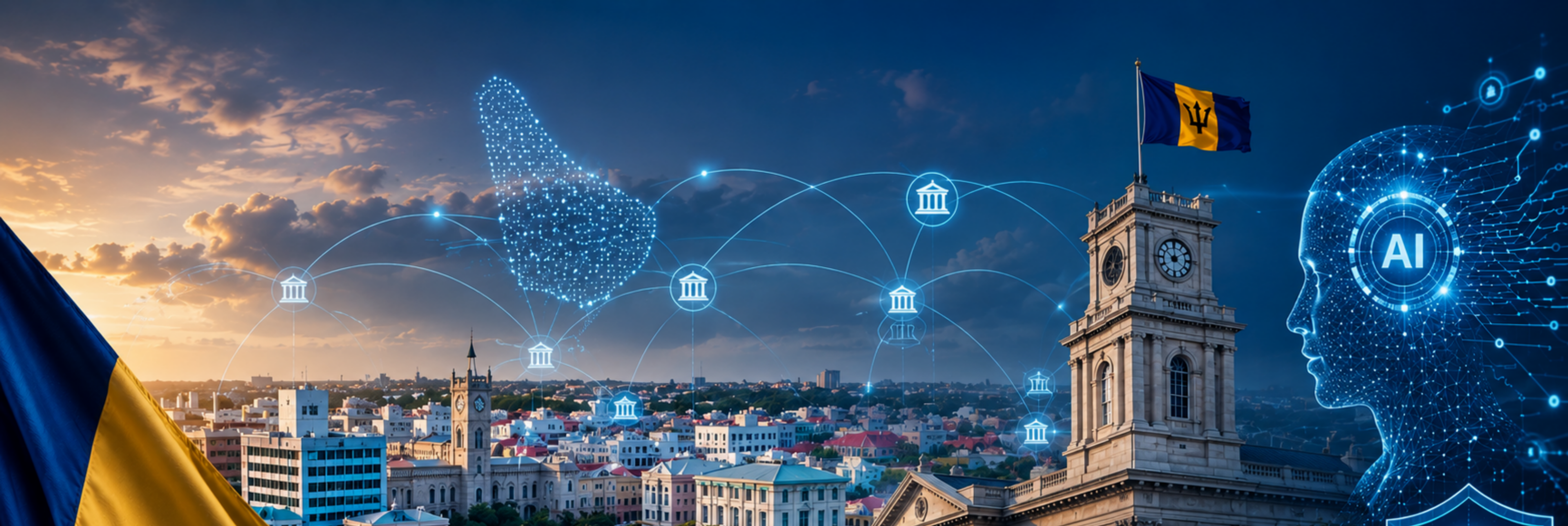
Barbados has quietly launched one of the Caribbean's largest AI projects. While much of the region continues to debate artificial intelligence, Barbados has already deployed it.
The launch of Pearly, an AI-powered citizen engagement platform developed by Touchstar Group, represents one of the Caribbean's most ambitious public-sector technology projects. The platform allows citizens to report issues, upload photographs, submit locations, and communicate directly with government services while automatically routing requests across 155 government entities.
From an innovation perspective, Pearly demonstrates what Caribbean technology can achieve. From a leadership perspective, it introduces an entirely new level of data, privacy, and accountability risk.
Every photograph uploaded, every GPS location submitted, every conversation held with an AI assistant, and every automated decision generated by the system potentially falls within the scope of the Barbados Data Protection Act.
For executives throughout the Caribbean, the larger question is no longer whether organizations will deploy artificial intelligence; it is whether they understand the liabilities that accompany it.
Under the Barbados Data Protection Act, organizations that process personal information assume significant legal responsibilities. Serious breaches of the legislation may result in penalties of up to BBD $500,000, alongside potential criminal liability for directors and responsible officers; equally important is the reporting timeline.
Organizations may have as little as 72 hours to identify, investigate, assess, and report certain data incidents. For organizations handling AI systems, this creates a difficult operational challenge because many businesses still lack visibility into where data travels, how algorithms process information, and which third parties have access.
The financial consequences extend far beyond regulatory penalties. A public data incident may trigger forensic investigations, legal expenses, regulatory reviews, crisis communications, technology remediation, and loss of public confidence. For organizations operating in financial services, telecommunications, healthcare, government, and technology, reputation itself often becomes the largest financial exposure.
The cost of compliance is measurable, but the cost of losing trust rarely is.
Artificial intelligence changes the nature of responsibility. Pearly does not simply collect information. It creates new questions for executive leadership.
What happens if photographs contain identifiable individuals? What happens if location data reveals behavioural patterns? Who reviews automated decisions? Who ensures that data is deleted? Who remains accountable when an algorithm makes the wrong decision?
The Barbados Data Protection Act increasingly places responsibility on organisations to answer these questions before systems are deployed rather than after incidents occur. The concept of move fast and break things does not translate into regulated environments.
Privacy by design, data minimisation, impact assessments, and continuous oversight are rapidly becoming operational requirements.
"...scaling a localized AI network across 155 state entities means compliance cannot be an afterthought. Every piece of user-submitted media and telemetry must be strictly partitioned, audited, and secured to ensure absolute alignment with the BDPA, proving that Caribbean innovation can be both disruptive and completely responsible."
As Akira Jemmott, Software Developer and Data Compliance Lead at Touchstar Group, made clear, the lesson extends far beyond Barbados.
Organizations throughout the Caribbean are rapidly deploying chatbots, AI assistants, automated workflows, and customer-facing intelligent systems. Many are focused on efficiency, productivity, and customer experience, but fewer are asking what happens when the regulator arrives.
Because in Barbados, the future of artificial intelligence may not be defined by innovation alone. It may be defined by whether organizations can explain how their systems work, where their data travels, and who remains accountable when something goes wrong.
Reference source
https://www.datareform.gov.bb/